I get asked about Dex every so often, usually by someone who's already looked at a handful of apps built to help you remember people and is trying to figure out which one applies to them. Fair question. On paper, Dex and BuddyLog sound like they're solving the same problem: help me remember people and stay in touch. (If you want the category-level version of this distinction rather than the Dex-specific one, this guide covers friendship journals versus personal CRMs more broadly.)
In practice they barely overlap. They're built for different relationships, different habits, and honestly, different kinds of people. I've spent enough time thinking about both to say this without any bitterness: Dex is a genuinely well-built tool. It's just not building the same thing I am.
So instead of pretending there's no comparison to make, here's the actual one.
The vibe check
Before the feature list, there's a mood difference, and it's honestly the bigger tell. Opening Dex feels like clearing out LinkedIn notifications before a Monday — useful, a bit like admin. Opening BuddyLog feels like scrolling back through old camera roll photos and getting distracted for twenty minutes. Same category of app on a comparison chart. Not remotely the same Tuesday evening.
The short version
| Dex | BuddyLog | |
|---|---|---|
| Category | Personal CRM | Friendship journal |
| Built for | A large professional network — investors, founders, former colleagues, industry contacts | A small circle of people you actually love — close friends, family, your inner circle |
| How data gets in | Auto-synced from LinkedIn, Gmail, Outlook, and your calendar | Manually, by you, on purpose |
| Platforms | Web, iOS, Android, browser extension | iPhone, iPad, and Android |
| Where your data lives | Dex's cloud servers | Your device, with optional sync through your own iCloud on iPhone and iPad |
| Account required? | Yes | No |
| Pricing | Freemium, with paid tiers as your network grows | Low-cost, with a generous free tier |
Where Dex actually shines
If your contact list runs into the hundreds — investors you've pitched, people you met at a conference three years ago, former coworkers scattered across five companies — doing that manually is a losing battle. That's the exact problem Dex is built to solve.
Its whole value proposition is automation. Connect it to LinkedIn and it'll flag when someone changes jobs or gets promoted. Connect it to your email and calendar and it stitches together a timeline of every interaction, so you can look at a name and immediately see when you last emailed, met, or called — without having to remember any of it yourself.
That's genuinely useful if your networking is wide rather than deep. Founders, freelancers, recruiters, anyone whose job depends on staying top-of-mind with a large web of professional relationships — Dex takes work that would otherwise require a full-time assistant and automates most of it. It's a hub, not a diary, and it's good at being a hub.
The version of this I actually recognise: you're thirty seconds from sitting down with an investor you met at a conference two years ago, and you need the quick brief before you walk in — new firm, new fund, had a second kid since you last spoke. Nobody remembers that unprompted. Dex is built to hand it to you anyway.
Where BuddyLog actually shines
BuddyLog starts from a different premise: your closest relationships aren't the ones you're at risk of forgetting because you have too many of them. You're at risk of losing touch with your best friend, your sister, the person who's known you since you were nineteen — not because your network is too big to manage, but because life gets busy and nobody's automatically tracking it for you.
There's no LinkedIn sync in BuddyLog. No inbox scanning. That's not a missing feature — it's the point. The people you'd add aren't professional contacts whose job title needs auto-updating. They're people whose birthday you actually want to remember writing down yourself, whose inside jokes you want to log because you thought of it, not because an algorithm surfaced it.
The manual part is the feature. Logging a coffee chat, a phone call, or a memory takes fifteen seconds — and that fifteen seconds of intention is exactly what turns "I should really check in with them" into something that actually happens.
The other piece is privacy, which matters more the closer someone is to you. There's no account to create. Your data lives on your device (and, on iPhone, can sync through your own iCloud) — I never see it, because it's never on a server I control. For notes about your professional network, that might not matter much. For notes about your family, your closest friends, the people you're not always proud of how you talk about behind closed doors — it matters a lot.
And because it's built around a small circle rather than a sprawling network, BuddyLog can do things Dex has no reason to: a calendar view of the time you've actually spent with someone, stats on how often you see each person, small milestones that make staying close feel like something worth celebrating rather than a chore.
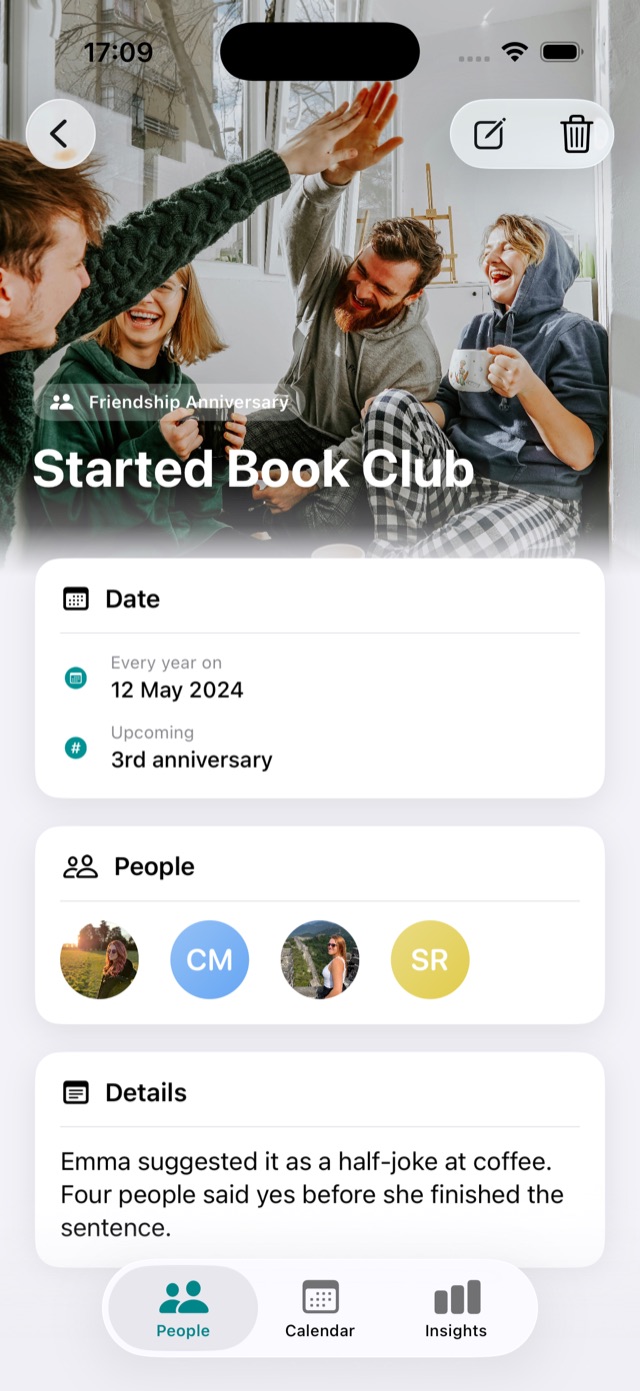
The version of this I actually recognise: your friend mentions, halfway through an unrelated conversation, that her mum's surgery is "next Tuesday." You mean to check in. Tuesday arrives, you're buried in your own week, and you remember on Thursday instead — which is a worse text to send. Log the date when she says it, and BuddyLog remembers Tuesday even when you don't.
So which one do you actually need?
Honestly — it might be both, for different parts of your life. Plenty of people have a professional network worth automating and a handful of close relationships worth being intentional about, and those are different muscles.
If you do end up running both, the split sorts itself out fast. Anyone you'd only ever see in a blazer belongs in Dex. Anyone you've seen in pyjamas at 11am with no explanation belongs in BuddyLog.
But if you had to pick one: reach for Dex if the problem you're solving is "I have too many professional contacts to track manually." Reach for BuddyLog if the problem you're solving is "I keep meaning to check in with the people I actually love, and I don't want an algorithm anywhere near that."
I built BuddyLog because that second problem was mine. If it's yours too, it's free to start, no account required. For the broader picture beyond this one comparison, see the complete guide to friendship journals.