Here's the math nobody warns you about before you move abroad. Two weeks home. Family gets first claim on most of it, understandably. That leaves maybe seven or eight free evenings, realistically fewer once jet lag and one inevitable stomach bug take their cut. And the friend list alone, from the school-era core group down to the friend of a friend I've somehow stayed close with since a wedding in 2019, is nowhere close to fitting into that. This is a fairly extreme version of a problem keeping a friendship journal is built to solve.
Too many people. Too few evenings. Some of those evenings have to be group hangouts just to make the numbers work at all. You do not need a spreadsheet to see the problem. I made one anyway.
Option A: the core four, every single time
The obvious move is to protect your closest people and let everyone else fall where they fall. See your best friend, your sister's best friend who's basically family, the two people you'd call at 3am. Every trip, without fail. It's efficient. It's honest about who actually matters most. And it works fine, right up until the third year in a row that someone you used to be genuinely close with realizes they haven't seen you since a wedding, while your core four have had dinner with you four Christmases running.
Nobody says anything the first time. By year three, somebody says something.
Option B: the rotation
The other option is to spread it around on purpose. Keep a mental note of who you saw last trip, and deliberately pick someone different this time, so that over a few years everyone gets a turn. It feels fairer. Democratic, even. Nobody gets permanently benched.
It also means you go two, sometimes three years between seeing people you're genuinely fond of, and every one of those catch-ups opens with the same twenty minutes of "so what have you been up to" that a closer friendship wouldn't need. You're not neglecting anyone on purpose. You're just optimizing for fairness over closeness, and closeness is usually what people actually wanted from you in the first place.
Neither option is good. Both are what happens when you try to solve a scarcity problem with a fairness principle, or a fairness problem with a scarcity principle.
So I started sorting them
What I actually landed on, somewhere around year two of this, was a hybrid, and I want to be honest about how it started: a note on my phone, then eventually a spreadsheet, with a column for "last seen" and a column for roughly how close I still felt to that person. Before every trip home, I'd sort by longest gap, cross-reference against who I actually missed, and build the eight-evening itinerary from there. It's the same problem that eventually became the whole reason I built BuddyLog, I just didn't know that yet.
I didn't have a name for what I was doing at the time. I just called it "figuring out who to see." It turns out there's a whole category of app built to do exactly this: something that functions as a friend tracker, letting you sort the people in your life by how long it's actually been since you saw them, rather than trusting your gut, which is bad at this and always has been. Once I noticed that, the spreadsheet started looking a lot less unhinged and a lot more like a prototype.
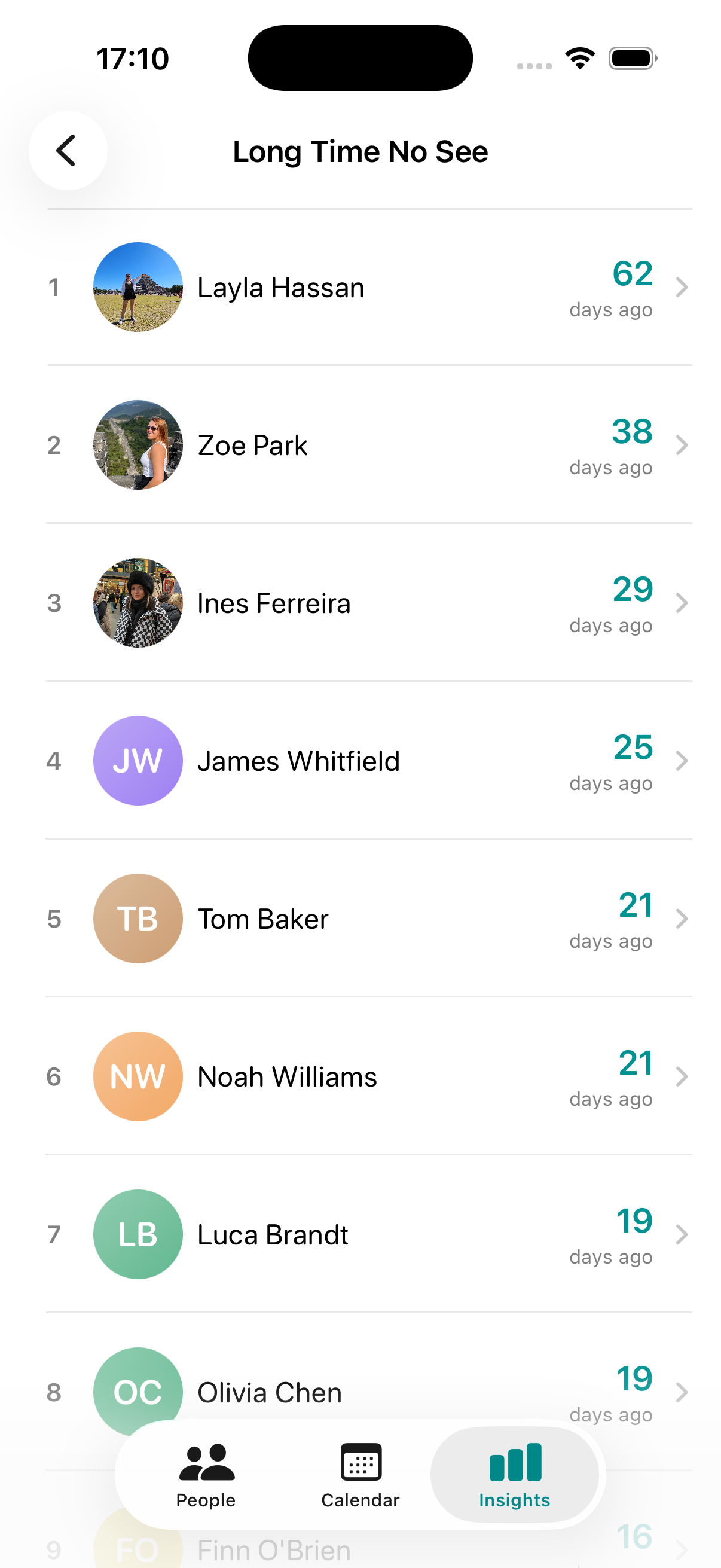
This is what that same sorting instinct looks like now, minus the spreadsheet. BuddyLog has a whole screen built around it, sorted automatically by how many days it's been since you last saw each person, which turns "who should I make time for this trip" from a guilty, half-remembered guess into a list you can just scroll through.
Relief, or morally bankrupt? Let's just say both
Here's where I've landed after several trips home running this system: sorting your friends by how overdue they are isn't cold. Not seeing them at all is cold. The sorting is just what happens after you admit you can't see everyone, and decide to be honest with yourself about who's actually falling through the cracks instead of pretending it isn't happening.
The relief is real. Not agonizing over the guest list every single trip. Not relying on memory to tell me it's been eleven months since I saw someone I'd call one of my closest friends. A little bit of a social tracker app, quietly doing the accounting my guilt used to do badly.
The "morally wrong" part, if it's there at all, isn't the sorting. It's that any of us have to ration our own closest people to fit inside eight evenings a year. That's not a personality flaw. That's just what living far from home costs, and no amount of clever sorting fixes the actual number of days you get.
The system doesn't decide who matters to me. It just stops me from accidentally letting someone matter to me for three years without telling them.
Where BuddyLog fits into all of this
BuddyLog is the version of that spreadsheet I actually wanted back then: a place to log who you saw and when, search and sort your people by how long it's been, and set a reminder for the friend who's quietly become overdue. It's the closest thing I've found to a friend sorting app that doesn't feel transactional, because the sorting isn't the point. It's just how you find out, in time to actually do something about it, who's been waiting longest to hear from you.
It won't get you more than eight evenings home. Nothing will. But it makes sure the eight you do get go to the right people, on purpose, instead of whoever you happened to think of first while jet-lagged in an airport arrivals hall. For the wider case for keeping something like this at all, see the complete guide to friendship journals.