Why you forget what your friends tell you
Forgetting a friend's news feels like a character flaw. Mostly, it's just memory working as designed.
Forgetting is fastest right at the start. In 1885, Hermann Ebbinghaus tested his own memory over days and weeks and found that forgetting is steepest in the first hours and days, then levels off. His forgetting curve has held up well: a 2015 replication by Jaap Murre and Joeri Dros found almost the same shape. So the name of your friend's new partner, heard once over a loud dinner, is most at risk in the 24 hours after you hear it, which is exactly when you're least likely to write it down.
Conversation competes with listening. Psychologist Malcolm Brenner described the next-in-line effect in 1973: people remember less of what was said just before it was their turn to speak, because part of their attention went to planning what to say. Ordinary conversation is a long chain of almost-your-turn moments. You were listening, just not all the way.
Names are uniquely slippery. In a 1987 study by Kathryn McWeeny and colleagues, people were better at remembering that someone was a baker than that someone was named Baker, even though it's the same word. A job carries meaning and connects to other things you know. A name is an arbitrary label with nothing to hang on to. That's why you remember your friend's son plays football but not that he's called Luka.
You're tracking a lot of people. Each friend comes with their own cast of partners, kids, coworkers, and ongoing dramas. Robin Dunbar's research suggests most people maintain around 5 very close relationships and about 15 close ones, and that's before counting anyone else's family. Dunbar's number, explained goes deeper on those limits. Holding all of that in your head was never realistic.
Why remembering is worth the effort
The best reason to remember details is what it lets you ask. A team at Harvard Business School led by Karen Huang studied live online chats and speed dates, and published their findings in 2017. People who asked more questions were better liked, and one type of question did most of the work: the follow-up. A follow-up question shows you listened. It turns "how are you?" into "how did the interview go?"
You can't ask a follow-up about something you forgot. Remembering details is what makes the most effective kind of question possible.
There's also the simpler point that being remembered feels good. When someone asks about your mum's surgery a month later, it tells you that you take up some space in their life between visits. In a close friendship, that's the whole point.
Which details are worth remembering
You don't need to log everything. A few kinds of detail account for nearly all the "you remembered!" moments.
| Type of detail | Examples | Why it pays off |
|---|---|---|
| Their people | Partner's name, kids' names and rough ages, a sibling they're close to, the dog | Forgetting these is the most awkward kind of forgetting, and they come up constantly |
| Open storylines | A job search, a move, a health scare, a renovation, an exam | The best source of follow-up questions, and they have a natural "how did it go?" date |
| Dates beyond birthdays | A wedding anniversary, a due date, the anniversary of a loss, their first day at a new job | Few people remember these, so a message on the day stands out |
| Preferences | Vegetarian, doesn't drink, allergic to nuts, hates surprise parties | Small practical details that make hosting and gifting easier |
| Things they said | A line that made you laugh, advice they gave you, a plan you made together | The texture of the friendship, and the best material for a toast or a card |
| Your shared history | How you met, trips you took, the last time you saw each other | It reminds you how long you've known someone and when it's been too long |
If you only start with one row, make it open storylines. Names and dates are nice to remember. Storylines are what let you follow up.
A simple system for remembering details about people
None of this needs a special memory technique. It needs a place to put things and a couple of habits around it. Psychologists call this cognitive offloading: using something outside your head, like a note or a calendar, so your memory doesn't have to do the job alone. A 2016 review by Evan Risko and Sam Gilbert describes how often people do this and how it frees up memory for other things. Writing a birthday in a calendar is one example. This is the same idea applied to everything else.
Write it down within a day. The forgetting curve is steepest at the start, so the best time to capture something is on the way home, not at the end of the month. Thirty seconds is enough: "Mia's starting at the new school Monday. Tom's dad has the surgery on the 20th."
File it under the person, not the date. A general notes app or a journal sorted by day makes you remember when someone told you something before you can find it. The question you'll actually have is "what's going on with Tom?", so the notes should live with Tom.
Give storylines a follow-up date. When something is unresolved, note roughly when you'll know the outcome. Interviews, scans, house viewings and exams all have one. That's the day to text "how did it go?"
Reread before you see them. Spend a minute skimming your notes before a dinner or a call. It's the same thing a good doctor does before an appointment, and it means the details are fresh at the moment you need them, not three days later.
Make names mean something. Because names are arbitrary, link them to something with meaning the first time you hear them: "Luka, the football one" sticks far better than "Luka." Saying the name back once in conversation helps too.
Keep it private, and leave some things out. These notes are for you. If a friend tells you something in confidence that they wouldn't want recorded anywhere, respect that and don't write it down. Writing "having a hard time, check in next week" is usually enough.
Where to keep your notes
Any tool works if you'll actually use it. Most people end up with one of these:
- The notes field in your contacts. It's already filed under the person and always on your phone. The downside is it's one undated block of text, so you can't see what's new or when you last saw someone.
- A general notes app. Fast to write in, but it drifts into a pile. One note per friend helps, but nothing reminds you to look.
- Your calendar. Good for follow-up dates and anniversaries, bad for everything else.
- A friendship journal. A dedicated log of the people you care about, with notes, dates, and the times you spent together, all in one place per person. The friendship journal guide covers what it is and how it differs from a contacts app or a personal CRM.
Whatever you choose, the habits above matter more than the tool.
Isn't it a bit calculated to take notes on friends?
It can feel that way at first. But we already accept this for birthdays: nobody thinks less of you for having a calendar reminder instead of memorizing 40 dates. Teachers keep notes on their students, doctors on their patients, good managers on their teams. None of them care less because of it. The note doesn't replace caring about someone. It makes sure your caring turns into a text on the right day instead of a guilty "sorry, I totally forgot" two weeks later.
The real test is what you do with the notes. If they help you ask better questions and show up when it matters, they're doing their job.
How BuddyLog helps you remember
I built BuddyLog partly because my own notes about friends were spread across my contacts, a notes app, and my camera roll. In BuddyLog, everything is filed under the person. Each profile holds your notes and the things they've said that you want to keep (quotes). You can link the people in their life, like a partner, kids, or siblings, so their names are right there next to your friend. When you log a hangout, you can add notes and photos to it, and the profile shows what you did last time and what's coming up next, which is handy as a quick reread before you see them.
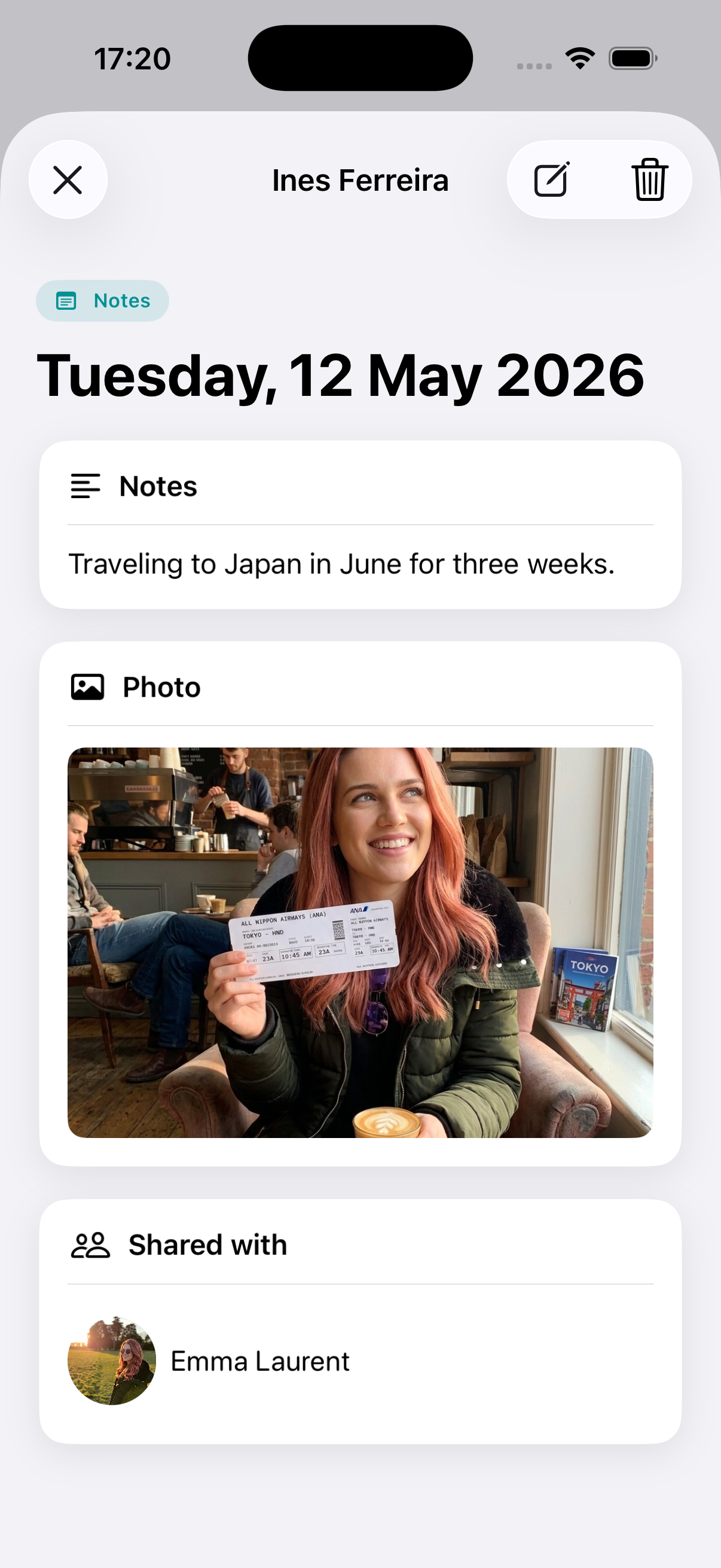
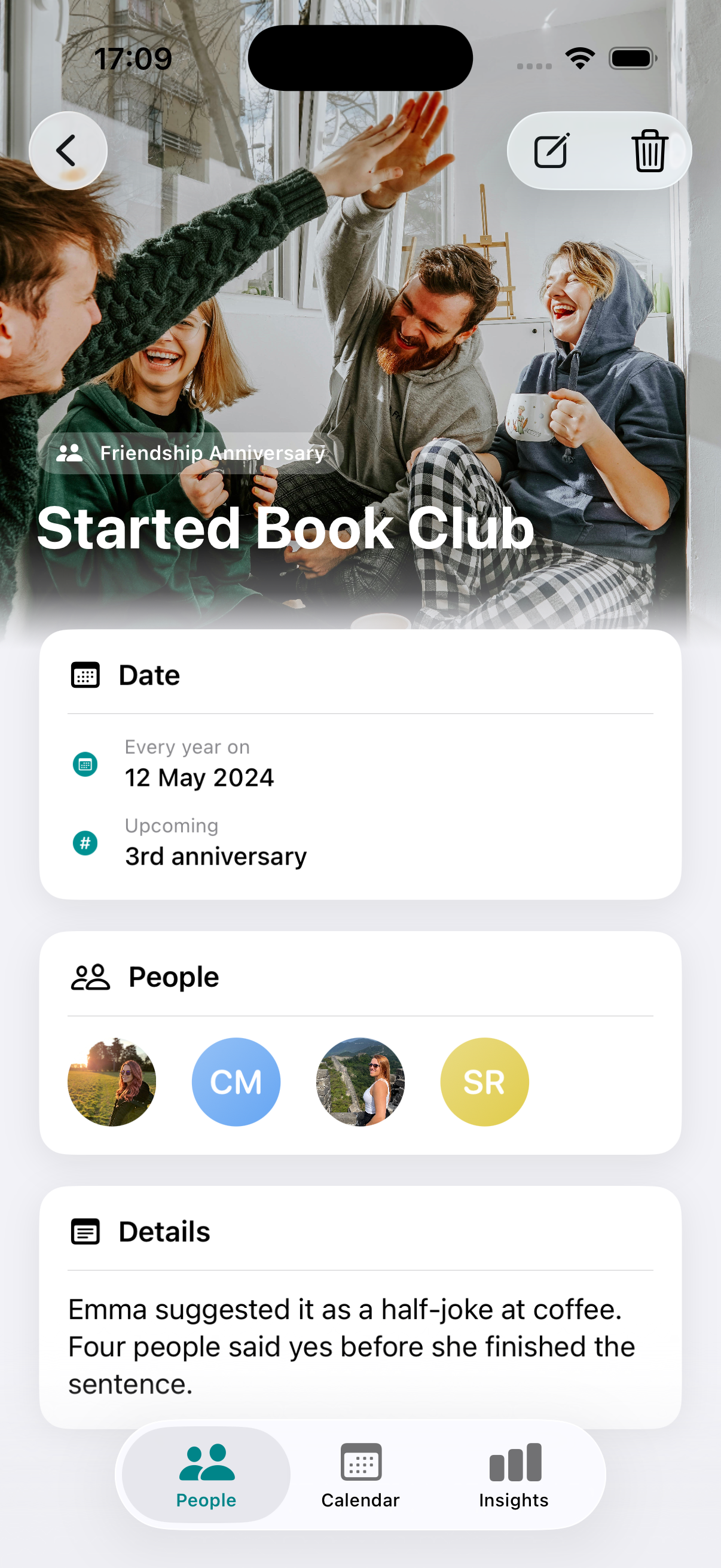
Birthday notifications cover the dates everyone expects you to remember. Anniversaries cover the ones nobody expects you to, and How We Met keeps the story of where your friendship started. Check-in reminders give you a quiet nudge when it's been a while since you saw someone. Everything stays on your device (with optional iCloud sync on iPhone), and nobody sees your notes but you. Anniversaries, quotes, and How We Met are part of Premium. Notes, events, birthdays and reminders are free.
Quick answer: To remember details about your friends, write them down within a day of hearing them (forgetting is steepest early on), file the notes under the person rather than the date, give open storylines like interviews or medical tests a follow-up date, and reread your notes for a minute before you see someone. Focus on the names of the people in their life, ongoing storylines, and dates that matter to them. Remembered details make follow-up questions possible, and research links follow-up questions to being better liked.
FAQ
How do you remember details about people?
Write details down within a day of hearing them, file them under the person, note when open storylines will resolve, and reread your notes before you see that person. Memory alone isn't built to hold this much detail about dozens of people.
Why do I forget things my friends tell me?
Mostly because of how memory works. Forgetting is steepest in the first day or two after you learn something, and the next-in-line effect means you remember less of what was said just before you were about to speak.
Is it weird to write down notes about your friends?
Not if they stay private and help you show up better, the same way a birthday reminder isn't weird. Just leave out anything shared in confidence that your friend wouldn't want written down.
What details about friends are most worth remembering?
The names of the people in their life, ongoing storylines like a job search or a sick parent, dates beyond their birthday, practical preferences, and things they said that stuck with you. Storylines matter most, because they let you ask a follow-up question.