Nobody remembers exactly where the number ten came from. It wasn't borrowed from anywhere, no website, no show, no list format we'd all seen somewhere else. She just made it up on the spot, mid-conversation, as a way to threaten us with exclusion from a group that, by definition, had no room to exclude anyone from. That's what made it funny. We were maybe five people total. Congratulations on making the cut for a list with five empty spots on it.
The joke that never needed a reason to exist
The birthday threat came and went, but the "top 10" stuck around and turned into a running scoreboard for the whole group. Remember something small she'd mentioned weeks ago, unprompted: straight to number one. Skip the hangout she'd spent a week organizing: dropped to number ten, publicly, in the group chat, with a full explanation of the offense. Someone's parents happened to own a boat: instant, entirely unearned promotion, no correlation required. It never had rules. It didn't need any. Everyone just understood the bit and kept feeding it, year after year, long after any of us could have told you why "top 10" specifically was the unit we were measuring each other in.
That's the part that gets me now. None of us decided to keep a running record of each other's highs and lows. It just happened, one joke at a time, because we kept showing up for each other long enough for the bit to have new material. A private joke like that isn't really about the joke. It's a receipt. Proof that a group of people has history that nobody outside the group would understand, and that's worth something.
Then everyone got a job, a partner, and a mortgage
We still text the ranking back and forth, but it's noticeably rarer than it used to be, for the obvious reason: we don't see each other every week anymore. One of us moved cities for work. Two have kids now, which means an evening out has to be planned a month in advance around a babysitter. The rest of us are just busy in the ordinary, unglamorous way adults are busy. Nobody decided to see each other less. It just happened, the same way the joke itself just happened, except this time it's working against us instead of for us.
I've told this exact friend group that I was building an app about staying close to people, and the top 10 bit was the first thing they brought up. Not the birthday parties, not the sleepovers. The joke. It's the thing that's stayed most consistently ours, and also the clearest evidence of how much rarer our actual hangouts have gotten.
How often do adults actually see their closest friends?
It's not just our group. Research on adult friendship backs up exactly what it feels like: a widely cited 2021 survey from the Survey Center on American Life found the share of Americans with at least six close friends had dropped by more than half since 1990, and a third of adults said they'd lost touch with most of the friends they used to have. Separate research on how friendships form, from communication professor Jeffrey Hall, puts a number on the cost of building a close friendship in the first place: somewhere around 200 hours of time together. That's not a number you rack up by accident once you're juggling a job and a family. It takes intention, the same intention it used to take zero effort to produce back when you saw the same five people at lunch every single day.
The joke survived because we kept it alive on purpose. The hangouts got rarer because nobody was doing the same for those. Both take the same kind of intention. Only one of them usually gets it.
Why the small stuff is worth tracking, not just the big stuff
Most advice about staying close to friends is about the big, obvious things: birthdays, weddings, the milestones everyone remembers on their own anyway. Almost nobody talks about tracking the small stuff, and the small stuff is usually what a friendship is actually made of. It's the running joke nobody outside the group would get. It's remembering that it's been four months since you last actually saw someone in person, not just liked their story. It's the detail from a phone call three weeks ago that you meant to bring up next time and already half forgot. None of that shows up on a calendar. All of it is exactly what people mean when they say a friendship "feels close" or "feels distant," even when nobody can point to a single specific event that caused the shift.
I've written before about why people keep journals in the first place, and a lot of it comes down to the same instinct: the things that feel unforgettable in the moment are usually the first things to go. A private joke that's been running for fifteen years feels permanent right up until the year nobody mentions it, because everyone assumed someone else remembered where it started. Nobody wants to be the friend group that let the bit die quietly. It just takes someone actually keeping track.
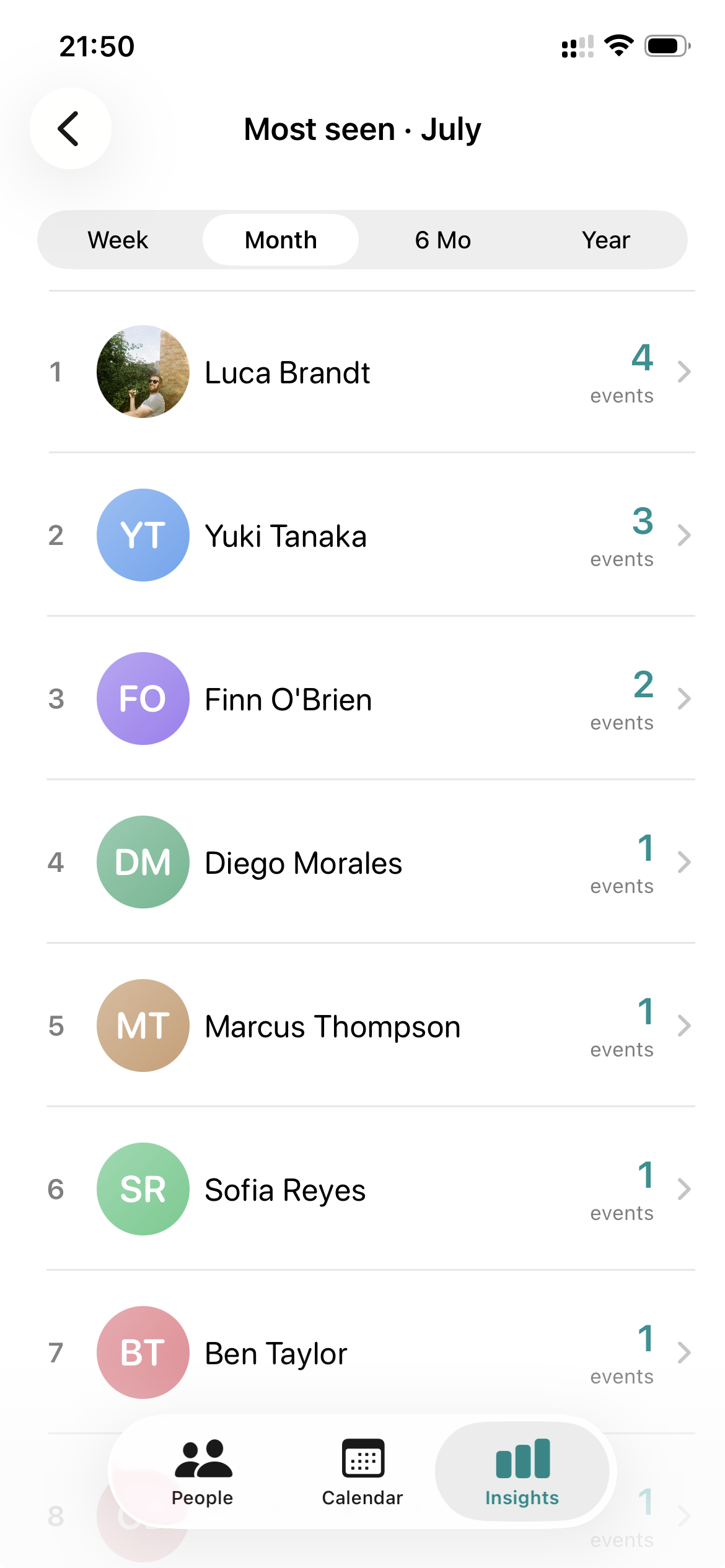
This is the part I didn't expect to like as much as I do: seeing it laid out plainly. This is my own "most seen friends" stat from July, and it's a small, honest way to check whether the people you'd call your closest friends are actually the ones getting your time, or whether that's quietly drifted without anyone deciding it should.
Where BuddyLog fits into this
BuddyLog exists for exactly this kind of thing: not just the milestones, but the running jokes, the inside references, and the honest gap since you last actually saw someone. You can log a memory the day the joke gets a new entry, so the origin story doesn't get fuzzy by year fifteen. You can set a reminder for the friend you haven't actually seen in person in three months, before "we should really catch up" turns into another six months of good intentions. It's not trying to replace the group chat where the top 10 rankings still get argued over. It's just there so the small stuff, the private jokes and the actual frequency of your hangouts, doesn't quietly slip through the same cracks everything else does once life gets full.
Our top 10 joke is fifteen years old this year. None of us wrote that down anywhere, so I'm doing it now, here, since apparently that's what it takes.