The guest list is three decisions wearing one name
The common mistake is treating "guest list" as one flat brainstorm, when it's really three separate questions bundled together under one spreadsheet tab: how big is the pool you're even drawing from, who in that pool are you still actually close to, and what will the resulting mix of people feel like once they're all in one room. Conflating them is a big part of why guest lists take three planning sessions and still feel wrong. You're trying to answer three unrelated questions with one column of names.
Question one: how big is the pool you're actually drawing from?

Before narrowing anything, you need an honest starting list: not who comes to mind first, which tends to skew toward whoever you talked to last week, but everyone you've actually kept as part of your life at some point. If you keep any kind of running record of people, a note, a spreadsheet, an app like BuddyLog, a stat like Total Buddies, an all-time count plus your peak year for adding people, is a useful gut check before a guest list gets touched at all. It's rarely the number people expect on the first look. A pool that turns out much bigger than the budget allows is a filtering problem, which is fine, that's what the next two questions are for. A pool that's smaller than assumed is worth knowing too, so the list gets built generously instead of padded nervously at the end.
Question two: who's still actually close enough to invite?

The genuinely hard part of a guest list isn't the pool, it's the people in it you haven't actually spoken to in years: the college roommate, the work friend from a job you left in 2019, the person who was in every photo from a trip nobody's mentioned since. Memory rounds all of these down to "we're still close," because that's easier than admitting how much time has actually passed. A stat like Long Time No See, sorted by exactly how many days it's been since you last saw someone, removes that rounding. It doesn't decide who to invite. A three-year gap caused by living on different continents means something different than a three-year gap caused by a friendship quietly fading, and only you know which one you're looking at. What it does is turn a vague feeling, "I think we've drifted," into an actual number you can weigh on purpose, instead of finding out from an unanswered invite which side of that line someone landed on.
The stat doesn't decide who's still close enough to invite. It just stops "we're basically still close" from making that call by default.
Question three: what will the room actually feel like?
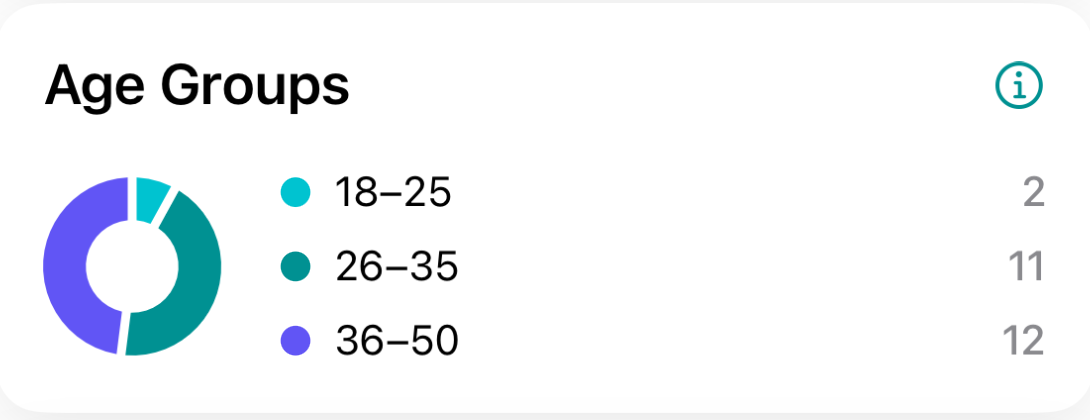
Once the list is close to final, there's a question guest counts alone don't answer: what does the room actually look like once everyone in it says yes? A list built purely from "everyone I love" can quietly skew toward one decade, mostly people in their late twenties and early thirties, for instance, while somehow forgetting that a real chunk of the people you love most are your parents' age, or a partner's much younger cousins. A stat like Age Groups, breaking your circle into age ranges, is a cheap way to catch that before the seating chart does it for you. It's not a reason to exclude anyone. It's advance warning for the parts of a wedding that actually depend on who's in the room: music that lands for one generation and not another, speeches that assume everyone gets the same references, a dance floor built around one age bracket's idea of a good night.
Turning three numbers into an actual list
None of these stats make the decision for you, and that's the point. What they do is take the parts of a guest list that memory handles badly, how many people you actually know, how long it's really been since you saw someone, what the group will look like once assembled, and turn them into something you can look at directly instead of guessing at. What's left after that: who you actually want there, who deserves an invite despite the gap, whose feelings would be hurt by an omission, is the part a spreadsheet was never going to solve anyway. That part is supposed to be hard. It's just easier to get right once the easy parts stop being guesses too.
FAQ
How many people should be on a wedding guest list?
There's no universal number, it depends on budget and venue. The harder part usually isn't the number, it's who fills it. Start with an honest full list of everyone you'd consider, then narrow using how close you actually still are, not how close you remember being.
Should you invite friends you haven't talked to in years?
It depends on why the gap exists. A gap caused by distance or circumstance is different from one caused by a friendship quietly fading. Knowing exactly how long it's actually been, not how long it feels, is what turns this into a real decision instead of a guilty guess.
Why does the age range of your wedding guests matter?
It's not about excluding anyone. It shapes practical choices: music, seating, speeches, and the general feel of the reception. Knowing ahead of time whether guests skew toward one decade or span several avoids being surprised by the room once everyone has said yes.
Where BuddyLog fits
BuddyLog won't write the list for you, and it shouldn't. What it does is log the people in your life as you go, so questions like these have real numbers behind them instead of a guess made under deadline pressure. Total Buddies, Long Time No See, and Age Groups are three of the stats it calculates automatically from events you log in seconds, as part of BuddyLog Premium. If the bigger question is whether keeping that kind of record is worth doing at all, the full guide to keeping a friendship journal is the place to start.