The short answer, by circle
Not every friend needs the same amount of contact. Anthropologist Robin Dunbar's research describes relationships as a set of nested circles, each about three times bigger than the one inside it. Dunbar's number, explained covers those circles in detail. What matters here is that each circle comes with a typical rhythm of contact.
| Circle | Roughly how many | Typical contact | Who's usually in it |
|---|---|---|---|
| Inner circle | 5 | At least once a week | A partner, a best friend, maybe a sibling or parent. The people you'd call in a crisis. |
| Close friends | 15 | At least once a month | The friends you confide in and make plans with on purpose |
| Good friends | 50 | A few times a year | People you'd invite to a big birthday or a wedding |
| Stable relationships | 150 | At least once a year | People you could pick things back up with without it being awkward |
Two things to keep in mind. First, these figures describe what people with stable networks tend to do, not a target you're failing if you miss. Second, the boundaries are fuzzy, especially for the circle of 50, which Dunbar's work pins down less tightly than the others. Treat the table as a rhythm to aim for, not a schedule to enforce.
Where those numbers come from
Much of this research started with Christmas cards. In a 2003 study, Russell Hill and Robin Dunbar asked people in England to list everyone they sent a Christmas card to, how they knew them, and how often they were in touch. The average network came out at around 150 people, and contact clustered in tiers: a small group heard from all the time, a larger group regularly, and most people only occasionally.
Later work, including a 2012 review by Alistair Sutcliffe, Robin Dunbar, and colleagues, tied those tiers to both closeness and contact. The people we feel closest to are the people we're in touch with most often, and each step out into a bigger circle comes with less frequent contact. That's where the familiar shorthand comes from: weekly for the inner 5, monthly for the next 15, yearly for the 150.
It's worth being clear about what this does and doesn't show. The research mostly describes the link between closeness and contact. It doesn't prove that seeing someone weekly makes them a best friend. But the next study suggests the link runs at least partly in that direction.
Why friends need more upkeep than family
In 2011, Sam Roberts and Robin Dunbar followed a group of students for 18 months as they left home for university, which is about as clean a natural experiment in losing touch as you'll find. Nearly everyone saw less of the people back home. What changed was how much that mattered.
Friendships faded when contact dropped. Family mostly didn't. As the students saw their friends less and did fewer things with them, they felt less emotionally close to those friends. The same drop in contact with family barely moved how close they felt to their relatives. Family ties come with structure that keeps them going: shared history, obligation, the people who'll make sure you're at the holiday dinner. Friendships don't. They're held together mainly by the time you put into them.
Effort could slow the fade. In a 2015 follow-up, Roberts and Dunbar looked at which friendships held up. The ones that survived were the ones where people made extra effort. There was also an interesting gender difference: for women, talking more often did the most to keep a friendship from fading, while for men, doing activities together mattered more. Most of us know both kinds of friendship, and the takeaway is the same either way. A friendship you want to keep needs regular input, and what counts as input depends on the friendship.
This is also why "we're so close we can go a year without talking" friendships exist but are rarer than we'd like to think. Usually they're friendships that were built on hundreds of hours early on, which is the next point.
New friends need more time, not less
If the table above describes keeping a friendship, Jeffrey Hall's research describes building one. In a 2019 study, Hall estimated it takes about 50 hours together to go from acquaintance to casual friend, about 90 hours to become a friend, and more than 200 hours to become a close friend. How many hours it takes to make a friend goes through what those hours look like on a real calendar.
The practical upshot: a new friend you'd like to become close to needs to be seen more often than an old friend at the same level of closeness. Once a month is a fine rhythm to keep a 10-year friendship ticking over. For a friendship that's three months old, once a month means you'd need years to reach 200 hours. If you've met someone you click with, front-load the time. Weekly is not too much.
Does texting count?
Partly. In a 2012 study, Tatiana Vlahovic, Sam Roberts, and Robin Dunbar had people log their social interactions for two weeks, across face-to-face meetings, video calls, phone calls, instant messaging, texting, and email or social media. Two findings stand out.
- Longer only helped in person. Face-to-face was the only kind of interaction where spending more time together kept making people happier. A longer text thread didn't do the same.
- Laughter helped almost everywhere. Sharing a laugh made interactions feel better in nearly every channel, and a written "haha" seemed to do about as much as the real thing.
So texting is real contact, and a funny back-and-forth with a friend is doing something. But it's a top-up, not a replacement. For your inner circle in particular, try to make at least some of that weekly contact a call, a video chat, or time in the same room.
When you can't see them that often
Plenty of people can't hit weekly or monthly in person. Friends move cities, have kids, work nights, or live on another continent. I live abroad and see most of my closest friends during a couple of weeks home a year, so I've had to think about this more than I'd like. A few things help.
Keep the rhythm, change the format. If you can't see a friend monthly, call them monthly. A standing call (the first Sunday of the month, every other Thursday on the commute) takes the "we should catch up" negotiation out of it. What the research ties to closeness is regular contact. In-person is best, but regular matters more than perfect.
Spend rare visits on purpose. When your time is limited, the question isn't "who do I want to see?" (everyone) but "who have I gone longest without seeing?" That's how I ended up sorting my friends by who's overdue before every trip home.
Reach out more than feels natural. Many people hold back from messaging a friend they haven't spoken to in a while because it feels like it might be strange. In a series of experiments published in 2023, Peggy Liu and colleagues found people consistently underestimate how much a friend appreciates hearing from them out of the blue, and the gap was biggest when the message was more of a surprise. The friend you've been meaning to text is likely to be happier to hear from you than you think.
How to tell if you're seeing someone often enough
The hard part isn't knowing the ideal rhythm. It's knowing your actual one. Memory is bad at gaps: "I saw her recently" can easily mean four months ago. A few habits make the real picture visible.
Decide the rhythm per person. Go through your inner circle and close friends and give each one a rough target: weekly, monthly, every few months. You don't have to share it with anyone. Just deciding makes it obvious when someone's slipped.
Write down when you last saw them. A note with a date is enough. Once you can see the real number, you stop rounding it down.
Watch for the signs of drift. Starting every text with "sorry, I've been so bad at replying," or hearing their big news from someone else, are both clues that the rhythm has slipped. The signs you're losing touch with a friend covers more of them, and what actually helps.
How BuddyLog helps you keep the rhythm
That's most of why I built BuddyLog. You log a hangout in a few seconds, and every friend's profile shows when you last saw each other and what you did. Check-in reminders let you set a different rhythm for each person, in days, months, or years: every 7 days for your best friend, every month for a close friend, every 6 months for an old friend in another city. If the time runs out, you get a gentle nudge. Logging and reminders are free.
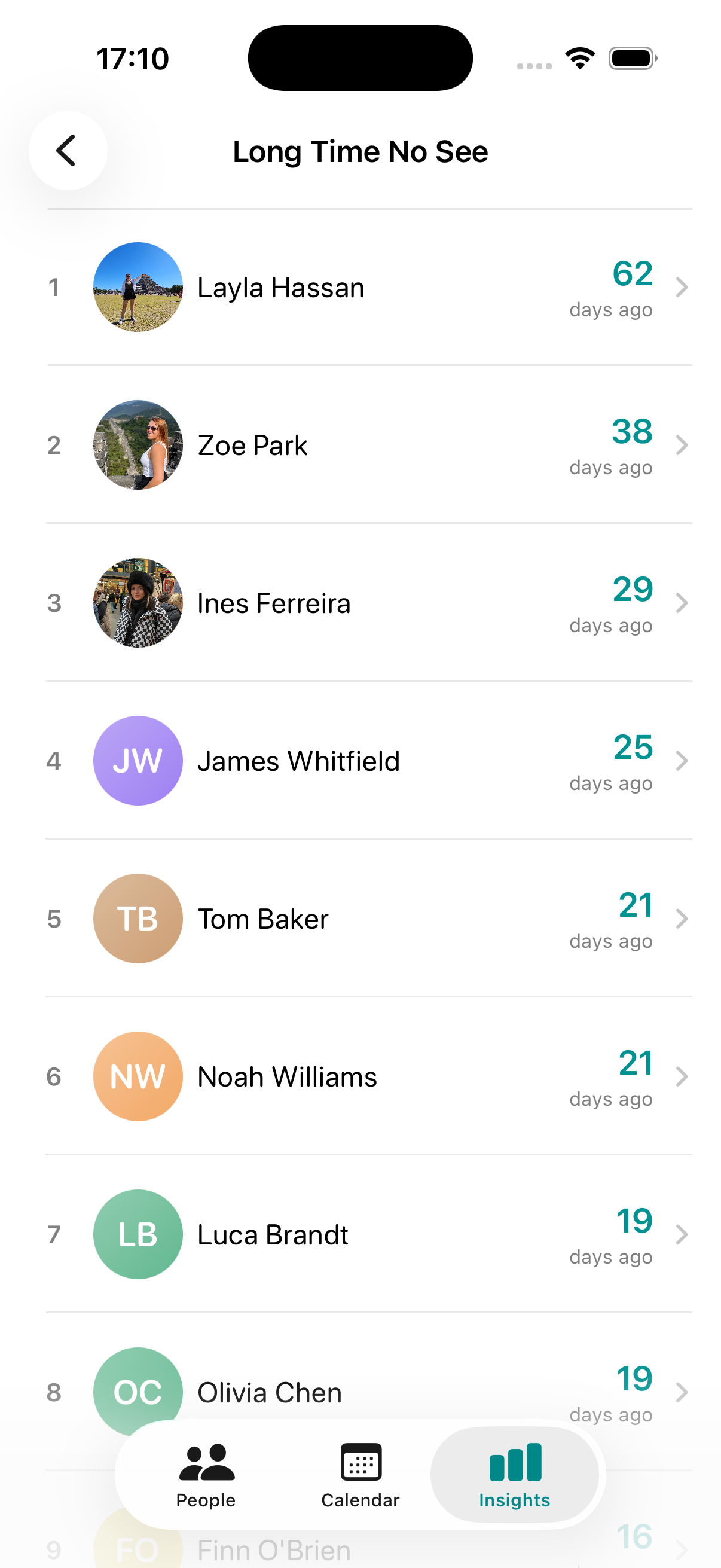
With Premium, Long Time No See sorts all your people by how many days it's been since you last saw them, so the friend who's quietly become overdue rises to the top on their own. Everything stays on your device (with optional iCloud sync on iPhone), and nobody else sees it.
If you're wondering whether keeping a record like this is worth it at all, the friendship journal guide covers what it is and how it differs from a contacts app or a personal CRM.
Quick answer: Research by Robin Dunbar and colleagues suggests seeing or talking to your closest 5 or so people about once a week, your wider circle of about 15 close friends about once a month, and the roughly 150 people you'd call stable relationships at least once a year. Friendships fade faster than family when contact drops (Roberts & Dunbar, 2011), so they need more regular upkeep. In-person time matters most, but calls and texts help fill the gaps when distance gets in the way, and new friends need more time than old ones to grow close.
FAQ
How often should you see your close friends?
Roughly once a week for your innermost circle of about 5 people, once a month for a wider circle of about 15 close friends, and at least once a year for the wider group of about 150. These are typical patterns from research, not strict rules.
How often should you talk to your best friend?
Most best friends sit in the inner circle, which research links to contact at least once a week. It doesn't all have to be in person, but face-to-face time is the kind where longer conversations keep making people happier.
Why do friendships fade faster than family relationships?
An 18-month study by Roberts and Dunbar (2011) found closeness to friends dropped when contact dropped, while closeness to family held up. Family ties have built-in structure. Friendships depend mostly on the time you put in.
How do you stay close to friends you can't see often?
Keep a regular rhythm of calls or video chats, plan the visits you do get around who you're most overdue to see, and reach out more than feels natural. Research shows people underestimate how much friends appreciate hearing from them.