What actually keeps a friendship going
When researchers study how friendships survive, the answer is mostly unglamorous. In a 2004 study, Debra Oswald, Eddie Clark and Cheryl Kelly identified four kinds of behavior that keep friendships going: positivity (being pleasant to be around), support, openness (sharing what's actually going on with you), and simple interaction (spending time together, in person or not). Friends who did more of these were more satisfied and more committed to the friendship.
Notice what's not on the list: grand gestures, perfect birthday gifts, or long catch-up dinners once a year. Jeffrey Hall's work on what he calls communicate bond belong theory points the same way. Ordinary, everyday talk, like a quick "how was your day" or a joke about something you both saw, does a lot of the work of keeping people close. It's the small stuff, repeated.
That changes the question. It's less "how do I find time for a proper catch-up?" and more "how do I keep a small amount of contact going without having to think about it?" If you want rough numbers for how often, by how close someone is, how often to see your close friends covers what the research suggests.
Make contact cheaper
The biggest reason people fall out of touch isn't lack of care. It's that every message starts to feel like it has to be worth sending. A few habits lower that cost.
Share, don't just check in. "Hey, how are you?" puts the work on the other person: they have to sum up weeks of their life in a reply. Sending something of your own is easier to answer. A photo of what you're cooking, a song you've had on repeat, a two-line update on the thing you were stressing about last time. It invites a reply without demanding one.
Use your voice more than feels natural. In a set of experiments published in 2021, Amit Kumar and Nicholas Epley asked people to reconnect with an old friend either by text or by phone. People expected a call to feel more awkward than a text and not to make much difference to how close they felt. They were wrong on both counts: talking by voice created noticeably stronger feelings of connection, without being more awkward. You don't need to book an hour-long call to get some of that. A voice note while you walk to the shop does a lot of the same job, and the other person can listen whenever suits them.
Let replies be slow. Plenty of friendships stall because one person feels guilty about replying late, so they wait until they can reply properly, which makes it later still. Agree, out loud if you need to, that late replies are fine. A thread that moves once every few days is still a thread.
Attach your friends to routines you already have
Willpower is a bad system for anything you want to do for years. Routines are better. Instead of trying to remember to call someone, link them to something that already happens.
- The commute or the walk. If you walk the dog every evening or drive the same route every morning, that's a regular slot for a call. One friend, one day of the week, and it stops being something you have to plan.
- Something you both follow. A show you watch at the same time, a sports team, a podcast, the same book. It gives you a reason to message that has nothing to do with "it's been a while."
- Something you do together, apart. A word game you take turns on, a shared photo album, a running playlist you both add to. Each move is a tiny bit of contact that costs almost nothing.
- A standing date. First Sunday of the month, the last Friday before payday, whenever one of you is back in town. A fixed point means nobody has to be the one who suggests it.
You don't need this for everyone. Pick it for the handful of people you'd be genuinely sad to lose touch with, and let the rest happen more loosely.
Staying in touch in the situations that make it hard
Most friendships don't drift because of a single big event. They drift when a life change quietly removes the thing that used to keep contact going. Here's what tends to get in the way, and what helps.
| Situation | What gets harder | What helps |
|---|---|---|
| One of you moved away | You lose the chance meetings and easy "want to grab a drink?" plans that used to do the work | Set up a regular call or running thread early, before the gap grows. Plan visits on purpose instead of hoping they happen |
| Different time zones | The hours when you're both awake and free shrink to almost nothing | Voice notes and photos you can send any time. Find your one overlap (often their morning, your evening) and protect it |
| A busy job or season | Every free evening feels already spoken for | Shrink contact rather than skipping it. A voice note on the commute counts. Say you're slammed instead of going quiet |
| A friend has a new baby | Their time, sleep and attention suddenly vanish, and plans keep getting cancelled | Go to them, keep visits short, and send messages that don't need a reply. Don't stop inviting them just because they've said no lately |
| Your friend group scattered | The group chat stays busy but you rarely talk to anyone one-on-one | Keep the group for banter and logistics, and keep separate one-on-one contact with the few you're closest to |
| You're always the one reaching out | It starts to feel one-sided, and resentment builds quietly | Check whether they show up when asked. If they do, keep initiating. If they don't, step back and say you miss them |
Moving away is the one I know best. I live abroad and see most of my close friends during a couple of weeks home a year, which is how I ended up sorting my friends by who's overdue before every trip. The friendships that survived the move weren't the ones with the most dramatic goodbyes. They were the ones where we kept some small, boring contact going in between.
New parents deserve a special mention, because this is where a lot of friendships quietly end. The parent stops being able to say yes for a while, the friend stops asking, and a year later they barely know each other. If you're the friend without kids, the most useful thing you can do is keep asking, make it easy (you come to them, at their time, for not very long), and send messages that don't need an answer. If you're the new parent, a one-line "I'm alive, I miss you, I'll be human again eventually" goes a long way.
Group chats aren't the same as staying in touch
A busy group chat can make you feel connected to everyone in it while you haven't actually spoken to any one person in months. There's a reason for that. In a 1995 study of how people naturally group up to talk, Robin Dunbar, Neill Duncan and Daniel Nettle found that conversations tend to split into smaller ones once more than about four people are involved. Groups are good for jokes, plans and passing on news. They're not where the openness and support that Oswald's study describes usually happens.
So use both. Let the group chat do what it's good at, and keep a separate thread, a call, or a regular coffee with the two or three people in it you're closest to. A direct message to one person in the group, picking up on something they said there, is one of the easiest openers there is.
When you're always the one reaching out
This is one of the most common complaints about adult friendship, and it's worth separating two very different situations.
They show up when you ask. Some people are simply bad at initiating. They're glad to hear from you, they say yes to plans, they're good company once you're together. They just never send the first message. If that's your friend, the friendship is mutual. It's just that the effort is split differently: you organize, they show up. You can say it lightly ("you're on planning duty next time") but it's often worth deciding to be the initiator and dropping the score-keeping.
They don't show up. If messages go unanswered, plans get cancelled, and nothing ever comes back, that's a different situation. It's fair to step back. Before you do, it's worth saying something honest and kind, like "I've missed you, and I've noticed it's usually me reaching out. No pressure, but I'd love to hear from you." Sometimes that's all it takes. Sometimes it isn't, and then you know.
Either way, it helps to know which one you're dealing with. Memory is bad at this kind of score, in both directions: it tends to overweight the times you felt ignored and forget the times they did reach out. If you've already noticed some of the warning signs, the signs you're losing touch with a friend goes into those and what helps.
If it's already been too long
The longer the gap, the bigger the first message seems like it has to be. It doesn't. The research here is reassuring. Peggy Liu and colleagues (2023) found people consistently underestimate how much friends appreciate being contacted out of the blue, and Erica Boothby and colleagues (2018) found people tend to underestimate how much others enjoy talking to them. The friend you feel awkward about texting is probably not feeling awkward about you at all.
Skip the long apology. A specific, easy opener works better: "I just walked past the place where we had that terrible pizza and thought of you. How are you?" Then, if it goes well, set up one small regular thing so you don't end up back here in six months.
Where BuddyLog fits
Everything above works with nothing more than a phone and good intentions. The part that tends to break down is noticing. Gaps between seeing people grow gradually, so three months feels like three weeks right up until it's been a year. I built BuddyLog, a private friendship journal, to do that noticing for me.
You log the times you see or talk to someone, which takes a few seconds, and BuddyLog keeps track of how long it's been. You can set a check-in reminder for anyone you want to keep a regular rhythm with, and you'll get a gentle nudge when it's been a while. When nothing is planned, the Home screen suggests the person you've gone longest without seeing, and an occasional Long Time No See reminder does the same. With Premium, the Long Time No See list sorts all your friends by how many days it's been since you last saw them, so the people who've quietly slipped are at the top rather than out of mind.
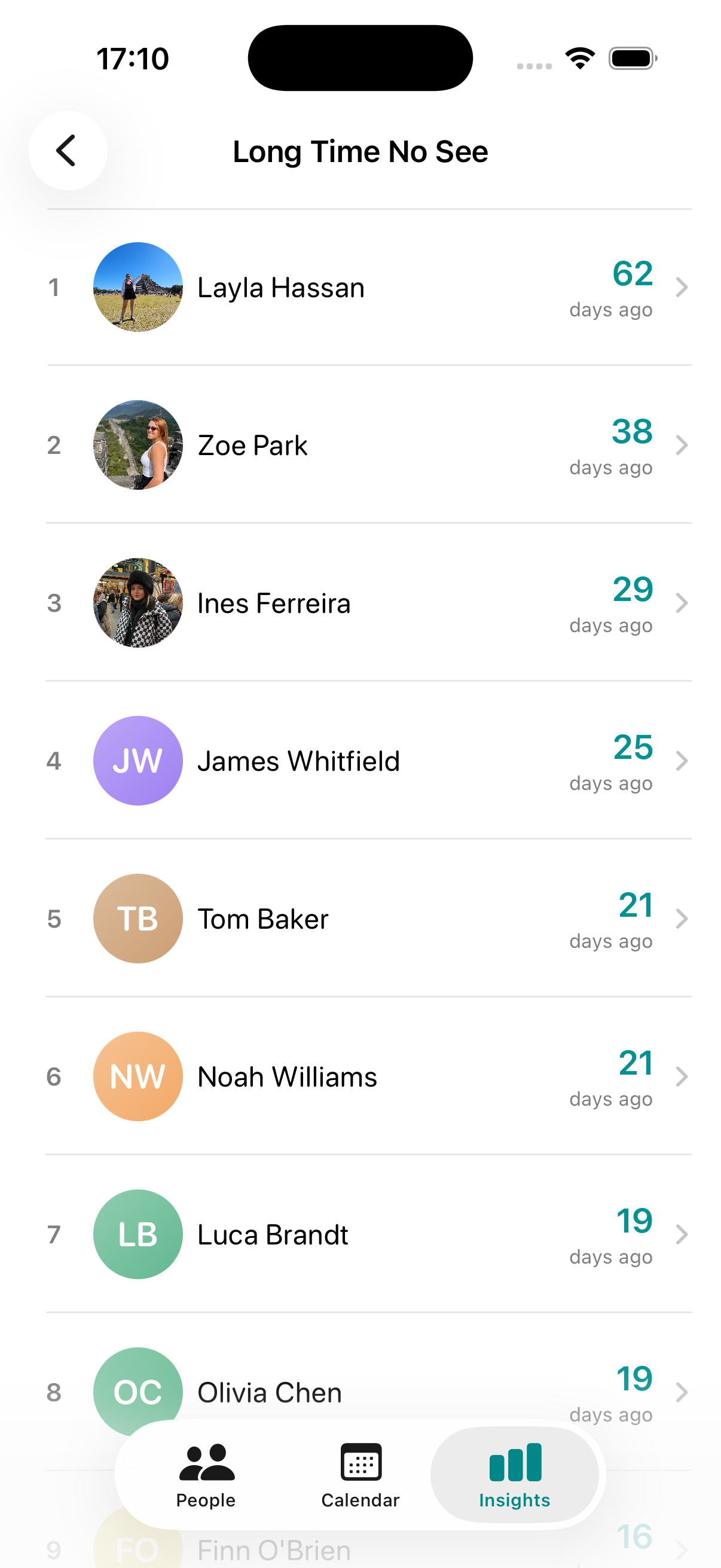
Each friend's profile also holds your notes, so when you do reach out you can pick up the storyline from last time instead of starting with "so, what's new?" Birthday notifications cover the most obvious reason to get in touch. Everything stays on your device (with optional iCloud sync on iPhone), there's no feed and no account, and nobody sees your list but you. Logging, notes, birthday notifications and check-in reminders are all free. The full Long Time No See list and the rest of the insights are part of Premium.
Quick answer: To stay in touch with friends, make contact small and regular rather than rare and big. Share things instead of only asking "how are you," use voice notes or calls (research by Kumar and Epley, 2021, found voice builds more connection than text without being more awkward), and attach friends to routines you already have, like a call on your commute or a show you both watch. Adjust for what's getting in the way, whether that's a move, time zones, a busy job or a new baby. Use group chats for banter but keep one-on-one contact with your closest friends, and don't let a long gap stop you from reaching out: people appreciate it more than you'd expect.
FAQ
How do you stay in touch with friends when you're busy?
Make contact smaller and attach it to things you already do, like a voice note on your commute or a call during a walk. A standing plan, like a monthly call on a fixed day, removes the need to negotiate a time. Regular small contact works better than big catch-ups that keep getting postponed.
How do you keep in touch with friends after moving away?
Agree on a rhythm early, before the gap grows: a regular call, a shared show or game, or a running thread of photos and updates. Plan visits deliberately, and spend limited trips home on the people you've gone longest without seeing.
Is a group chat enough to stay close to friends?
Usually not on its own. Real conversations tend to split once groups grow beyond about four people, and in a busy chat you can go months without talking to someone directly. Keep one-on-one contact going with the people who matter most.
What should I do if I'm always the one reaching out?
Check whether they show up when you ask. If they do, they may just be a bad initiator, and it's worth continuing. If they consistently don't, step back and tell them honestly that you miss them.
Is it awkward to text a friend you haven't talked to in a long time?
It usually feels more awkward to you than it is for them. Research shows people underestimate how much friends appreciate an out-of-the-blue message. A specific, low-pressure opener, like a shared memory, is the easiest way back in.
